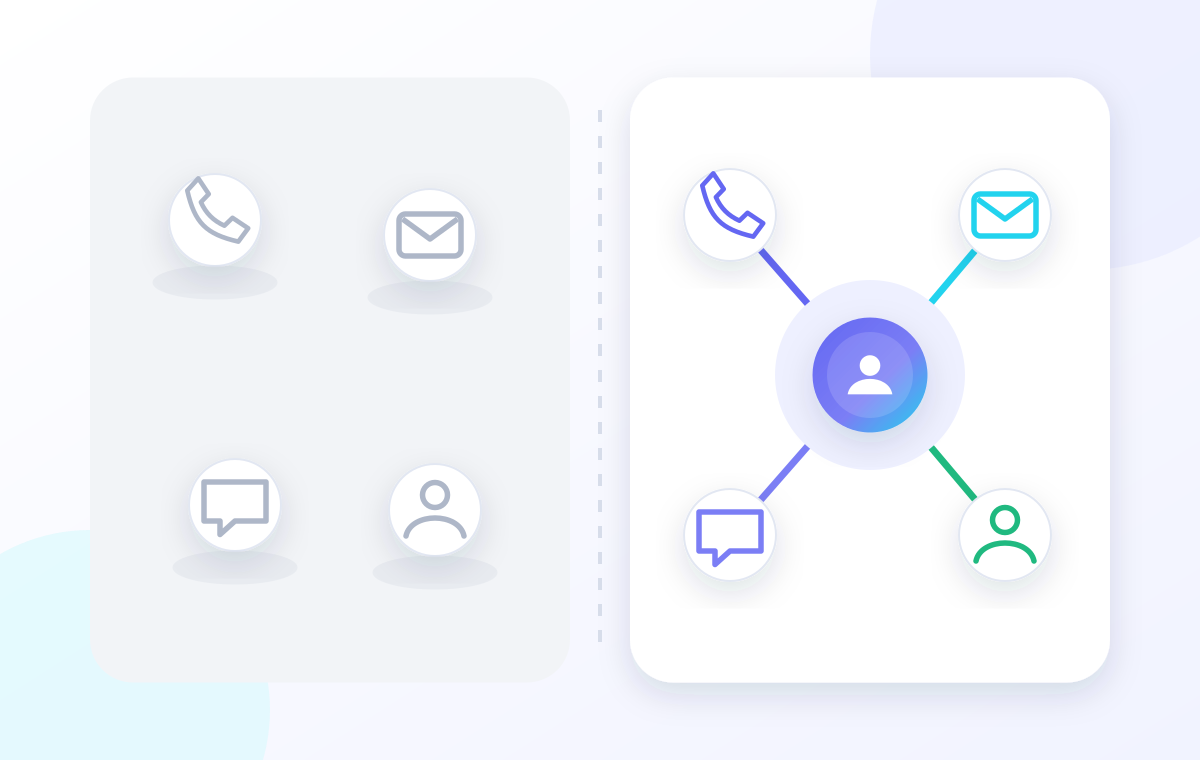
Customers do not think in channels — they think in outcomes. Multichannel contact centers offer many ways to reach the brand, but often each channel has its own queue, desktop, and reporting. Omnichannel contact centers unify identity, conversation history, and routing so every interaction builds on the last. The difference shows up in customer experience (CX) metrics: repetition, resolution time, and trust.
Definitions: Multichannel vs Omnichannel
Multichannel means “many channels.” Email, chat, voice, and social may all be supported — but agents may not see cross-channel context, and supervisors may manage each channel as a separate operation.
Omnichannel means “all channels in one coherent system.” A single customer profile, threaded conversations, and consistent service levels — regardless of how the customer engages.
Key Differences That Impact CX
| Dimension | Multichannel | Omnichannel | |-----------|--------------|-------------| | Customer identity | Often fragmented | Unified across channels | | Context | Frequently lost on switch | Preserved and threaded | | Agent desktop | Swivel-chair between tools | Single workspace | | Routing | Per-channel rules | Cross-channel skills and priorities | | Analytics | Siloed channel KPIs | Journey-level and channel-mix insight |
The operational gap is integration — not simply buying more channels.
Benefits of True Omnichannel Integration
Lower customer effort: When customers stop repeating themselves, Customer Effort Score (CES) improves — a strong predictor of loyalty.
Higher first contact resolution (FCR): Agents resolve issues faster when they see prior messages, attachments, and dispositions.
Better agent productivity: One desktop reduces handle time lost to tab-switching and copy-paste errors.
Stronger compliance: Consistent recording, consent, and disclosure policies across channels reduce regulatory variance.
Implementation: Building Blocks
1. Identity resolution — link phone, email, and user IDs to one golden profile 2. Unified conversation model — thread SMS, chat, and voice follow-ups as one case 3. Blended routing — align SLAs and prioritize VIP or high-risk journeys 4. Integrated knowledge — one source of truth for answers agents and bots share 5. Unified analytics — journey dashboards, not only channel dashboards
Vomenta approaches omnichannel CCaaS as a first-class architecture: agents work from a cohesive workspace while supervisors monitor holistic queue health — the kind of integration modern CX programs require.
Conclusion
Omnichannel vs multichannel is not a marketing slogan — it is an architectural choice with measurable CX impact. Multichannel checks the box on channel coverage; omnichannel earns loyalty by connecting every touchpoint. Invest in unified data, routing, and analytics, and treat integration as the product — not an afterthought.