Customer support is shifting from queue-and-wait to resolve-and-learn. AI voice agents — systems that speak with customers in natural language over the phone — are at the center of that shift. Unlike rigid IVR trees, modern voice AI uses a continuous loop of perception, reasoning, and speech generation. When implemented well, they cut wait times, stabilize costs, and free human agents for emotionally complex work.
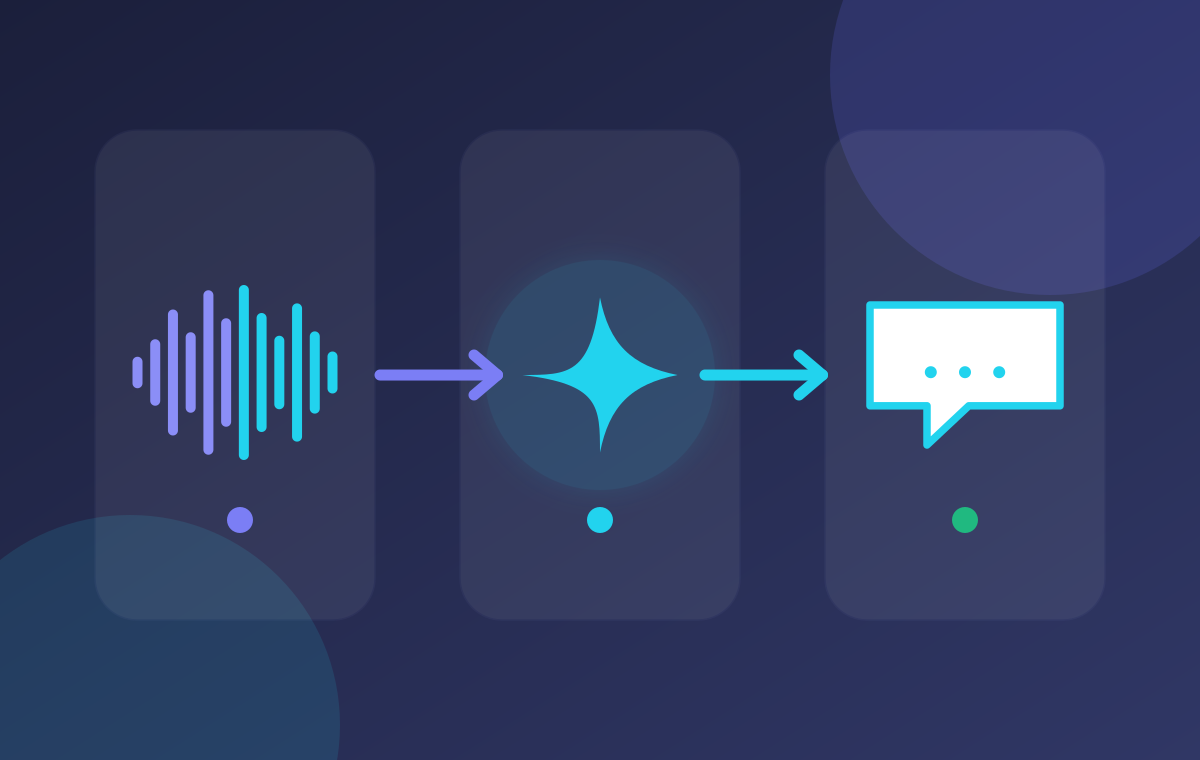
The STT → LLM → TTS Pipeline Explained
Speech-to-text (STT): Streaming ASR converts caller audio into text in near real time. Low latency matters; partial transcripts let the model start reasoning before the caller finishes speaking.
Large language model (LLM): The LLM interprets intent, applies policy, retrieves knowledge, and drafts a response. Grounding with your knowledge base, CRM fields, and order systems reduces hallucinations and keeps answers on-brand.
Text-to-speech (TTS): Neural voices deliver natural prosody and multilingual output. Many deployments use voice styles tuned for empathy in billing disputes versus efficiency in password resets.
Together, this STT→LLM→TTS pipeline powers conversational turns that feel fluid rather than transactional — especially when the platform optimizes end-to-end latency.
Use Cases That Deliver Value First
- Order status, appointments, and account lookups — structured data, high volume, clear success criteria
- Authentication flows — combine STT with secure, PCI-aware handoffs for sensitive steps
- Tier-1 troubleshooting — guided diagnostics with scripted branches validated by support SMEs
- Overflow and after-hours — instant answers when human staffing is expensive or unavailable
Vomenta supports BYOK for major AI providers so enterprises control keys, spend, and data policies while plugging into the same routing and analytics fabric as human agents.
Implementation Tips for Production-Grade Voice AI
Design for escalation: Define clear triggers — negative sentiment, repeated failures, regulatory topics — and pass full context to human agents.
Measure containment vs. quality: High automation is meaningless if CSAT drops. Track resolution rate, repeat contact rate, and CSAT by intent.
Continuous improvement: Mine transcripts for new intents, confused responses, and outdated knowledge articles. Treat prompts and tools as versioned assets.
Safety and compliance: Log consent for recording, honor opt-outs, and align outbound voice campaigns with TCPA and internal policies when AI places calls.
ROI: What Leadership Should Expect
Labor efficiency: Deflecting 30–50% of repetitive calls can materially reduce average handle cost while improving speed-to-answer.
Revenue protection: Faster answers reduce churn and cart abandonment in support-heavy industries.
Agent experience: Removing monotonous calls improves retention; pair AI with copilot features so humans stay in flow on hard cases.
Most organizations see measurable ROI within two quarters when they start with narrow, high-volume intents and expand based on data — not based on vendor demos alone.
Conclusion
AI voice agents are revolutionizing customer support by industrializing the STT→LLM→TTS loop at enterprise scale. Success requires crisp use cases, robust integrations, humane escalation, and ruthless measurement. Platforms that unify voice AI, human handoff, and omnichannel context — such as Vomenta — make it practical to deliver this revolution without fragmenting your operations stack.