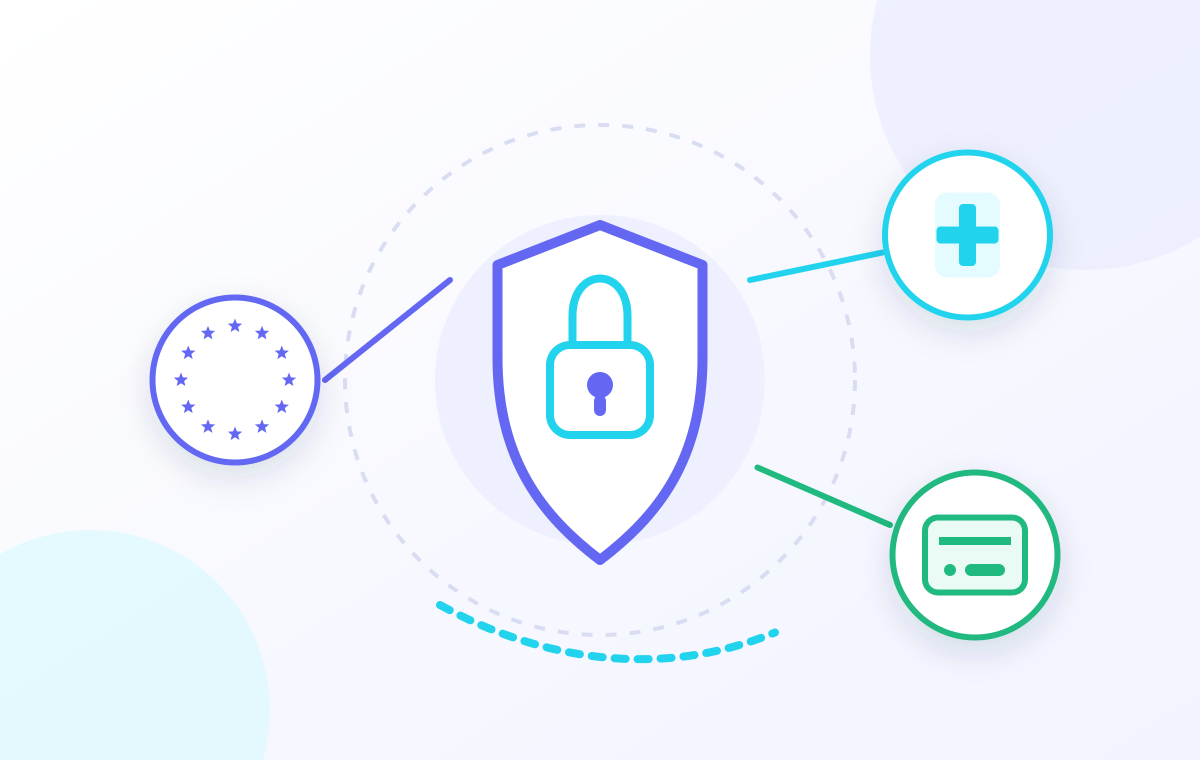
Contact centers are high-risk environments for data compliance. Agents interact with customers across voice, chat, email, and messaging channels — handling payment card numbers, health information, government identifiers, and other sensitive data in real time. A single compliance failure can result in regulatory fines, lawsuits, reputational damage, and loss of customer trust.
Yet compliance is often treated as a legal checkbox rather than an operational discipline. The result: policies exist on paper but aren't enforced in daily operations, agents aren't trained on the specific scenarios they encounter, and technology gaps create exposure points that go undetected until an audit or breach.
This guide covers the three major compliance frameworks that affect contact centers — GDPR, HIPAA, and PCI DSS — with practical operational guidance for each.
GDPR: Protecting European Customer Data
The General Data Protection Regulation (GDPR) governs the processing of personal data for individuals in the European Economic Area (EEA). It applies to any organization that handles EEA residents' data, regardless of where the organization is headquartered.
What GDPR Means for Contact Centers
Lawful basis for processing: Every piece of customer data your contact center handles needs a documented lawful basis — typically legitimate interest (processing is necessary for the service the customer is using) or consent (the customer has explicitly agreed). Marketing outreach and data sharing with third parties almost always require explicit consent.
Data subject rights: Customers have the right to access their data, correct inaccuracies, request deletion ("right to be forgotten"), restrict processing, and port their data to another provider. Your contact center must be able to fulfill these requests within 30 days.
Data minimization: Collect and retain only the data you actually need. If agents routinely collect full dates of birth for authentication but a birth year would suffice, you're collecting more than necessary.
Breach notification: If a data breach affects personal data, you must notify the relevant supervisory authority within 72 hours and affected individuals "without undue delay" if the breach poses a high risk to their rights.
Operational Checklist for GDPR
1. Call recording consent: Inform callers that calls are recorded and why. Many jurisdictions require explicit consent for recording — a simple "This call may be recorded for quality and training purposes" announcement may not be sufficient under GDPR. Document the legal basis for recording in your data processing records.
2. Agent training on data subject requests: Agents must know how to recognize a data subject request (SAR, deletion request, rectification) and route it to the appropriate team. Create a standard operating procedure with escalation paths and response templates.
3. Data retention policies: Define how long you retain call recordings, chat transcripts, and customer interaction data. GDPR doesn't specify retention periods, but you must justify the duration. Common practice: 6–12 months for quality management, 2–7 years for compliance-critical interactions (financial services, healthcare).
4. Third-party data processing agreements (DPAs): Every vendor that processes customer data on your behalf — your CCaaS provider, CRM, analytics tools, AI services — must have a DPA in place. Verify their compliance certifications and data handling practices.
5. Data residency: For EU customers, understand where their data is stored and processed. Some organizations require EU data residency — meaning customer data must remain within EU data centers. Verify your CCaaS provider offers this option.
6. Privacy by design: Build data protection into your operational processes, not as an afterthought. Mask sensitive fields in agent displays, limit data access to agents who need it, and implement automatic data anonymization for analytics and training datasets.
HIPAA: Safeguarding Protected Health Information
The Health Insurance Portability and Accountability Act (HIPAA) governs the handling of Protected Health Information (PHI) in the United States. It applies to healthcare providers, health plans, healthcare clearinghouses (covered entities), and their business associates.
What HIPAA Means for Contact Centers
If your contact center handles any form of PHI — patient names linked to health conditions, prescription information, appointment details, insurance claims, medical record numbers — HIPAA's Privacy Rule, Security Rule, and Breach Notification Rule all apply.
The Business Associate Agreement (BAA): If you're a contact center serving a healthcare organization, you are a business associate. You must have a BAA with the covered entity that specifies your obligations for protecting PHI. Your CCaaS provider, in turn, must have a BAA with you.
Minimum necessary standard: Agents should only access the minimum PHI necessary to perform their job function. A billing agent doesn't need access to clinical notes. A scheduling agent doesn't need access to diagnosis codes.
Operational Checklist for HIPAA
1. PHI in call recordings: Call recordings containing PHI are themselves PHI and must be protected accordingly. Implement encryption at rest and in transit, access controls limiting who can listen to recordings, and audit trails for every access.
2. Secure authentication: Before discussing any PHI, agents must verify the caller's identity using approved methods. HIPAA doesn't prescribe specific authentication methods, but industry practice includes multi-factor verification (date of birth + last four of SSN + security question).
3. Clean desk policy: Whether agents work in an office or remotely, screens displaying PHI must not be visible to unauthorized individuals. This means privacy screens on monitors, automatic screen locks after inactivity, and restrictions on screen capture tools.
4. Incident response plan: Document what happens when a potential PHI breach occurs — who is notified, how the breach is contained, how affected individuals are informed, and how the incident is reported to HHS. Drill this process at least annually.
5. Agent device security: For remote agents handling PHI, implement endpoint security requirements — company-managed devices with encryption, endpoint detection and response (EDR), and remote wipe capabilities. Personal devices handling PHI must meet the same security standards.
6. AI and PHI: If you're using AI copilot, voice agents, or analytics tools that process call transcripts or chat content, ensure the AI provider has a BAA in place and that PHI is handled according to HIPAA requirements. BYOK (Bring Your Own Key) for AI services is particularly important in healthcare — it ensures your organization controls the encryption keys and data doesn't flow through third-party systems without appropriate safeguards.
PCI DSS: Protecting Payment Card Data
The Payment Card Industry Data Security Standard (PCI DSS) governs the handling of payment card data (credit/debit card numbers, CVVs, and PINs). It applies to any organization that stores, processes, or transmits cardholder data.
What PCI DSS Means for Contact Centers
Contact centers that take payments over the phone — even if the agent simply reads a card number to enter into a payment system — are in scope for PCI DSS. The most relevant requirements for contact centers involve:
Scope reduction: The single most important PCI DSS strategy is reducing scope — minimizing the systems and processes that touch cardholder data. If agents never hear or see card numbers, those agents and their systems are out of scope.
Call recording and PCI DSS: This is the most operationally challenging intersection. PCI DSS prohibits storing the full card number and CVV in call recordings. If you record calls and customers read their card numbers aloud, you must either pause recording during the payment segment, mask the audio segment containing card data, or use DTMF (touchtone) payment capture that keeps card data off the voice path entirely.
Operational Checklist for PCI DSS
1. DTMF payment capture: The gold standard for PCI compliance in contact centers. The customer enters their card number using their phone keypad while the agent remains on the line. The DTMF tones are captured by a secure payment gateway and never reach the agent's headset or the call recording. This takes the agent desktop, network, and recording system entirely out of PCI scope.
2. Pause-and-resume recording: If DTMF capture isn't available, implement automatic recording pause when the agent initiates a payment workflow. The recording resumes after the payment is processed. Ensure the pause is triggered by the payment system, not manual agent action (which is error-prone).
3. Agent screen masking: If agents can see card numbers on screen, mask all but the last four digits. Payment processing should happen in a secure iframe or separate application that doesn't expose full card data to the agent desktop.
4. Network segmentation: Systems that handle cardholder data must be segmented from general contact center networks. Your CDE (Cardholder Data Environment) should have restricted access, dedicated firewalls, and enhanced monitoring.
5. Annual compliance validation: PCI DSS compliance must be validated annually through either a Self-Assessment Questionnaire (SAQ) for smaller merchants or a Report on Compliance (ROC) from a Qualified Security Assessor (QSA) for larger organizations.
Cross-Framework Considerations
Several operational practices apply across all three frameworks:
Access Controls and Least Privilege
Every framework requires that access to sensitive data is restricted to authorized individuals with a legitimate need. Implement role-based access controls (RBAC) that limit agent access based on their specific job function, queue assignment, and client affiliation (for BPO operations).
Audit Logging
Maintain comprehensive logs of who accessed what data, when, and why. Audit logs must be tamper-proof, retained for the required period (typically 1–7 years depending on framework), and reviewable on demand.
Encryption
All sensitive data must be encrypted both in transit (TLS 1.2+ for all network communications) and at rest (AES-256 for stored data). This applies to call recordings, chat transcripts, customer records, and any database containing personal or sensitive data.
Vendor Management
Your compliance posture is only as strong as your weakest vendor. Every technology provider — CCaaS platform, CRM, analytics, AI services, telecom — must meet the compliance requirements of the frameworks that apply to your data. Request and verify SOC 2 Type II reports, HIPAA BAAs, PCI AOCs (Attestations of Compliance), and GDPR DPAs as appropriate.
Agent Training
Compliance training must be specific, practical, and ongoing — not a once-a-year slide deck. Agents need to understand exactly what they should do when a customer reads their card number aloud, when a caller asks for their data to be deleted, when a patient asks about their medical records, when they suspect a data breach or unauthorized access.
Building a Compliance-First Contact Center
The most effective approach to contact center compliance is treating it as an architectural decision rather than a policy layer:
1. Choose a CCaaS platform with built-in compliance features: DTMF payment capture, recording pause-and-resume, data residency options, encryption at rest, RBAC, audit logging, and compliance certifications (SOC 2, HIPAA-ready, PCI DSS). Bolting compliance onto a non-compliant platform is expensive and error-prone.
2. Automate compliance controls: Manual processes fail. Use technology to enforce recording pauses during payments, mask sensitive data on agent screens, auto-expire data beyond retention limits, and flag potential compliance violations for review.
3. Embed compliance in quality management: Include compliance checks in your QA evaluation forms. AI-powered quality management can automatically flag interactions where agents may have deviated from compliance procedures — catching issues that random sampling would miss.
4. Document everything: Maintain current records of your data processing activities, security controls, vendor assessments, training records, and incident responses. When a regulator or auditor asks, you need to demonstrate not just that you have policies, but that you follow them consistently.
Key Takeaways
- GDPR, HIPAA, and PCI DSS all apply to contact centers that handle the relevant data types — ignorance is not a defense
- Scope reduction (especially for PCI DSS) is the most cost-effective compliance strategy — reduce the amount of sensitive data your agents handle
- DTMF payment capture is the gold standard for PCI compliance in voice contact centers
- BYOK for AI services is critical for healthcare contact centers handling PHI
- Compliance is an architectural decision, not a policy layer — choose technology that enforces controls automatically
- Agent training must be specific, practical, and ongoing — not annual slide decks
- Your compliance is only as strong as your weakest vendor — verify certifications and maintain current DPAs/BAAs