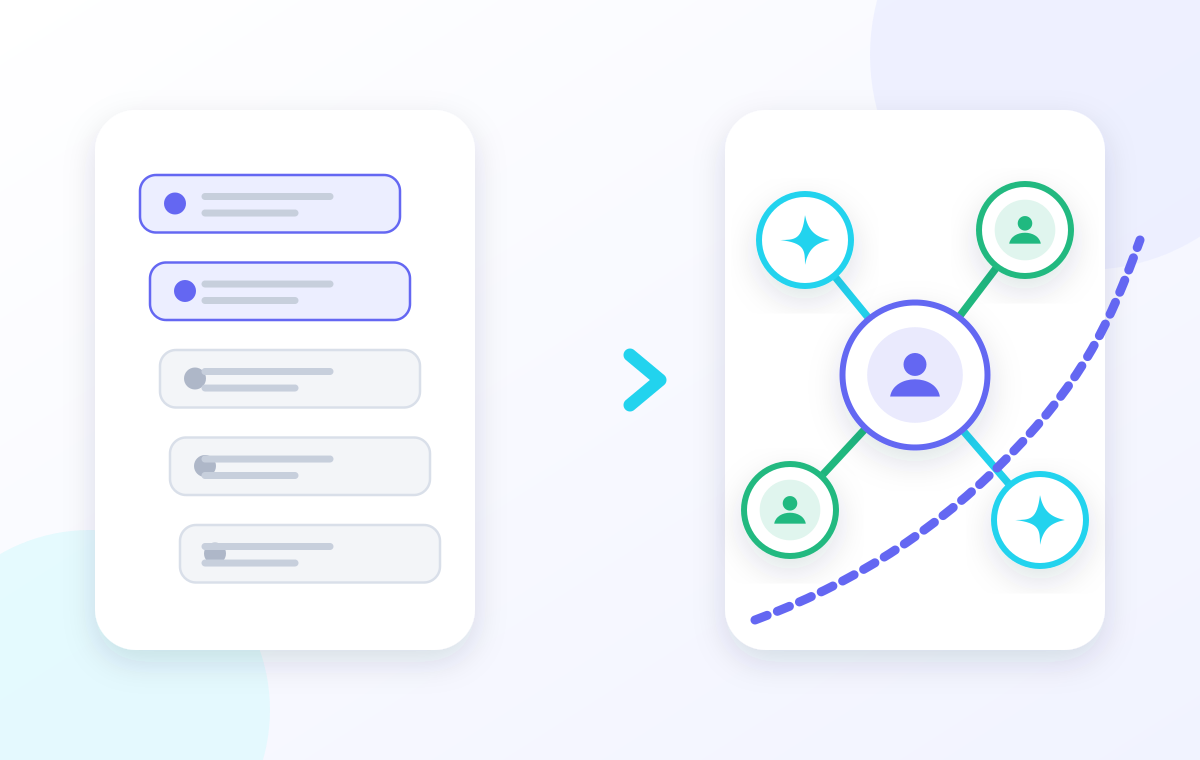
Customer service has always been a cost center that aspires to be a growth driver. In 2026, AI is finally closing that gap — not by replacing agents wholesale, but by reshaping every layer of the service stack: self-service resolution, agent augmentation, supervisor intelligence, and strategic workforce design.
The Three Eras of Contact Center AI
Era 1: Rule-Based Automation (2010–2018)
The first generation of "AI" in customer service was mostly branding. IVR systems with decision trees, keyword-based chatbots, and scripted FAQ deflectors handled narrow tasks but frustrated customers the moment a request deviated from the script. Containment rates hovered around 15–25%, and customer satisfaction with automated interactions was consistently negative.
Era 2: NLU and Machine Learning (2018–2024)
Natural Language Understanding (NLU) engines — powered by intent classifiers and entity extractors — improved comprehension dramatically. Chatbots could interpret phrasing variations, and speech analytics could flag calls for quality review. But these systems still operated within predefined intent taxonomies; they could understand what the customer wanted but couldn't reason about novel situations.
Era 3: Foundation Models and Autonomous Agents (2024–Present)
Large language models changed the game. Modern AI customer service systems can reason across unstructured knowledge bases, maintain multi-turn context over long conversations, generate grammatically correct and tonally appropriate responses in dozens of languages, and integrate with backend systems to execute actions — not just answer questions.
This is where the industry sits in 2026: AI that can actually do things, not just understand things.
How AI Is Reshaping Each Layer of Customer Service
Self-Service: From FAQ Pages to Conversational Resolution
Traditional self-service — knowledge base articles, static FAQs, community forums — puts the burden on the customer to find and interpret information. AI-powered self-service inverts this: the customer describes their problem in natural language, and the system finds, synthesizes, and delivers the answer.
RAG (Retrieval-Augmented Generation) is the core architecture. The AI retrieves relevant snippets from your knowledge base, product documentation, past ticket resolutions, and policy documents, then generates a contextual response grounded in your actual content. This approach dramatically reduces hallucination compared to pure generative responses while delivering answers that feel conversational rather than robotic.
Organizations deploying RAG-powered self-service in 2026 report 40–60% deflection rates on eligible contact types — significantly higher than the 15–25% typical of previous-generation chatbots.
Agent Assist: The AI Copilot Revolution
The most immediately impactful application of AI in customer service isn't automation — it's augmentation. AI copilot features enhance human agents without replacing them:
Real-time knowledge surfacing: As the customer describes their issue, the AI searches the knowledge base and displays relevant articles, past resolutions, and policy references — before the agent has to search manually. This typically reduces after-call work by 30–40% because agents spend less time looking up information.
Suggested responses: The AI drafts response text based on the conversation context, which the agent can accept, modify, or reject. This is particularly powerful for chat and email channels where typing speed is a bottleneck. Agents using AI-suggested responses handle 20–30% more interactions per hour without sacrificing quality.
Sentiment and intent detection: Real-time analysis of customer tone, escalation signals, and unstated needs helps agents adjust their approach proactively. A customer whose sentiment shifts from neutral to negative might receive a preemptive empathy statement or a proactive discount offer — before they ask for a supervisor.
Automated summarization: After each interaction, the AI generates a concise summary of the issue, resolution, and follow-up actions. This eliminates the manual note-taking that typically adds 60–90 seconds to every call in after-call work.
Supervisor Intelligence: From Sampling to Comprehensive Oversight
Traditional quality management relies on random sampling — a supervisor listens to 5–10 calls per agent per month and scores them manually. This approach is statistically unreliable and operationally expensive. AI transforms supervision in three ways:
100% automated quality scoring: Every interaction — voice, chat, email — is evaluated against your quality rubric. The AI assesses greeting compliance, empathy markers, resolution quality, compliance adherence, and upsell opportunities. Supervisors focus their limited time on the interactions flagged as outliers rather than random samples.
Coaching insights: AI identifies patterns in individual agent performance — not just what they're doing wrong, but specifically how to improve. "Agent Sarah handles billing disputes 40% faster than the team average but scores 15% lower on empathy markers during technical calls" is a coaching insight that would take hours to derive manually.
Anomaly detection: Sudden changes in handle time, escalation rate, or customer sentiment for specific agents, queues, or issue types trigger real-time alerts. This catches emerging problems — product defects generating unusual call patterns, new agents struggling with specific topics — before they impact service levels.
Workforce Design: AI-Informed Staffing Models
AI is changing not just how agents work but how contact centers are staffed. Accurate forecasting models powered by machine learning predict contact volumes with 95%+ accuracy at 15-minute intervals, enabling precise scheduling that reduces both overstaffing costs and understaffing service failures.
More fundamentally, AI automation changes the composition of the workforce. When AI handles 40% of routine contacts, the remaining human interactions are more complex, more emotionally charged, and more consequential. This means contact centers need fewer agents but more skilled agents — shifting hiring profiles from high-volume, low-cost to lower-volume, higher-value.
Implementation: A Practical Sequence
Organizations that succeed with AI in customer service follow a deliberate sequence rather than attempting everything at once:
Quarter 1: Deploy AI copilot for human agents. This delivers immediate value with low risk. Agents keep full control while benefiting from knowledge surfacing, suggested responses, and automated summarization. Measure impact on AHT, FCR, and agent satisfaction.
Quarter 2: Launch RAG-powered self-service. Use customer interaction data from Q1 to identify the highest-volume, most automatable contact types. Deploy conversational self-service for these categories and measure deflection rate and CSAT.
Quarter 3: Implement AI quality management. Replace random sampling with 100% automated scoring. This reveals quality patterns that were invisible with 5-call samples and enables targeted coaching programs.
Quarter 4: Introduce AI voice agents for targeted use cases. With three quarters of AI copilot and self-service data, you have clear evidence of which interaction types AI can handle autonomously. Deploy voice AI for these categories with robust human escalation paths.
Measuring AI Impact Without Vanity Metrics
The most common mistake in AI customer service projects is measuring the wrong things. Automation rate sounds impressive but means nothing if customers are frustrated. The metrics that matter:
- Customer Effort Score (CES): Did AI make it easier or harder for customers to resolve their issues?
- Repeat Contact Rate: Are AI-resolved issues actually staying resolved, or are customers calling back?
- AI-to-Human Escalation CSAT: When AI escalates to a human, is the handoff smooth? Is the post-escalation experience positive?
- Agent Satisfaction with AI Tools: Are agents finding AI copilot helpful or annoying? Agent adoption is the leading indicator of long-term success.
- Total Cost per Resolution: Not cost per interaction (which can be gamed by splitting issues across multiple contacts), but the all-in cost to fully resolve a customer issue.
The Human Element Remains Central
The most important lesson from early AI adopters is that AI amplifies human capability rather than replacing human judgment. The contact centers seeing the best results use AI to handle routine work so humans can focus on complex, emotionally nuanced, and high-value interactions.
Customers don't want to talk to a robot about a billing dispute that's causing them stress. They want instant answers for simple questions and empathetic, competent humans for everything else. AI in customer service succeeds when it delivers both — seamlessly routing between automated and human-assisted channels based on complexity, emotion, and customer preference.
Key Takeaways
- AI in customer service has evolved from rule-based automation to autonomous reasoning — the 2026 landscape is fundamentally different from even two years ago
- Start with agent augmentation (copilot), not full automation — it's lower risk and delivers immediate measurable value
- RAG-powered self-service achieves 40–60% deflection rates, dramatically outperforming previous-generation chatbots
- AI quality management replaces statistically unreliable sampling with comprehensive, consistent evaluation
- Measure customer effort and resolution quality, not just automation rate
- The future workforce is smaller but more skilled — plan hiring and training accordingly